The Jurassic of the Fili Park
Fili is a large park in Moscow, located on the right bank of the Moskva river. Among paleontologists in Moscow, Fili is known for decades for its very fragile fossils of the latest Jurassic, that is between 147 and 140 million years old. It took one hour to get to get from my home to Fili, which made it one of the most accessible fossiliferous locations for me. I often visited Fili with friends from my paleontology club. I walked from the underground station to the upper part of the park, with some houses, walking paths and playgrounds. Then I had to take some stairs to go down the abrupt slope and arrive on the bank.


Two creeks are visible from the quay. These creeks cut through Jurassic clay. The clay is black with a bluish tint and very different from usual soil. Fossiliferous strata are divided in three zones characterized by ammonite species (from oldest to youngest) : Epivirgatites nikitini, Kashpurites fulgens and Garniericeras catenulatum. The zone under nikitini, Virgatites virgatus, was only accessible on the Moskva bank before the quay was built.

First creek.

Second creek
Ammonites are one of the most common fossils here. They are exceptionally well-preserved: the pristine shell still subsists 1. But unfortunately they are also very fragile: the inside of the shell is filled with clay or weak phosphorite, or even empty. The only way to to keep an ammonite is to take it inside its surrounding matrix and consolidate it with glue before preparation. Despite this approach, few entire ammonites can be saved 2.
All three zones deliver ammonites, but it is in fulgens and catenulatum that the best specimens are found. We need to dig clay with a big shovel until we see an ammonite sticking out. Then a piece of matrix around the ammonite is taken out and packed with plastic film or aluminium foil (newspaper is not suitable as it won’t hold the specimen, without what it will fall apart). Brachiopod and bivalve inner moulds, as well as a lot of well-preserved belemnites, are also found.
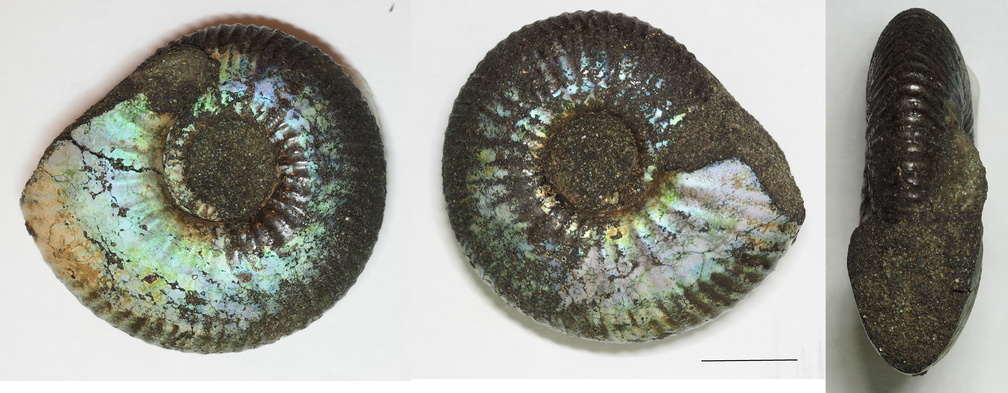
Craspedites subditus. ammonite. Scale bar = 1 cm
In fact, digging in Fili is much harder than one could imagine. The clay is very wet and flows everywhere. In my dig that exposed the catenulatum zone, we even had a little stream flowing right out of the wall. We had to dig a gutter to make a way out for the water and the mud. But clay, instead of flowing through, was constantly blocking the gutter, so we had to dig it again every ten minutes or so. It was also important to see the ammonites at the right time, as they could disappear forever in a mud flow from above.

And of course these creeks are full of mosquitoes. The problem is that, when you are digging, you can’t scratch yourself or kill mosquitoes. Once I was getting out an ammonite, and my back was all bitten by mosquitoes. When I got that ammonite out and packed it, I scratched my back against a tree. What a relief!
Vertebrates are also found there. An ichthyosaur skeleton with a complete skull was even found, but it disappeared in a private collection despite the will of a specialist to study it. But isolated teeth and vertebrae of sharks, bony fishes, plesiosaurs and ichthyosaurs are much less unique. Most of them are found in the nikitini zone, although fulgens contains the same fossils. They are found in a condensed lens using a sieve (these are very small fossils, ranging from several millimeters to 1 or 2 cm). This condensed lens is located at the level of water, and therefore it is constantly flooded. Big holes are dug to extract material from the condensed lens, and so water and mud flows to the bottom of the hole.

Apart from teeth, sea urchin spines (they indicate the right layer), gastropods and (unfortunately very fragile) bivalves and brachiopods can also be found.
Once I got out of my hole, with a large Fiskars shovel in one hand and a sieve filled with mud in the other, and started washing the sediment through the sieve. A little girl was walking in the park with her father when she saw me, and asked him: “Dad, what is the guy doing?”. And her father said with a very confident voice: “He’s gold panning” 3.
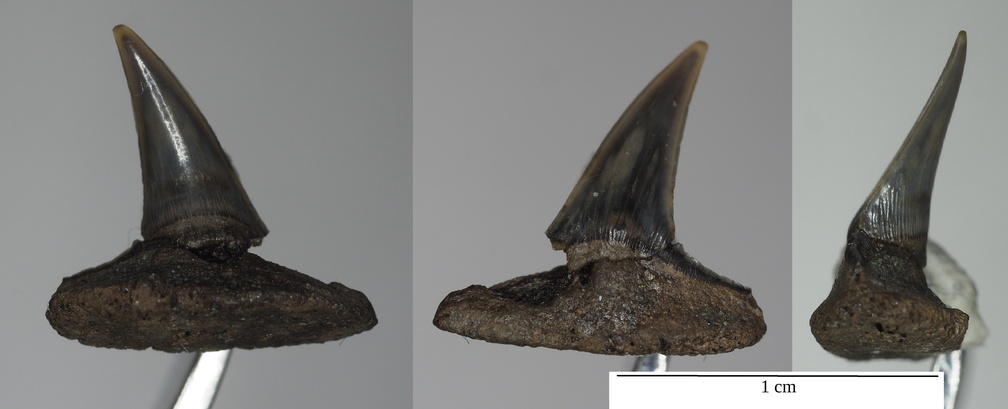
Sphenodus stschurovskii. shark tooth. Fili park, Jurassic
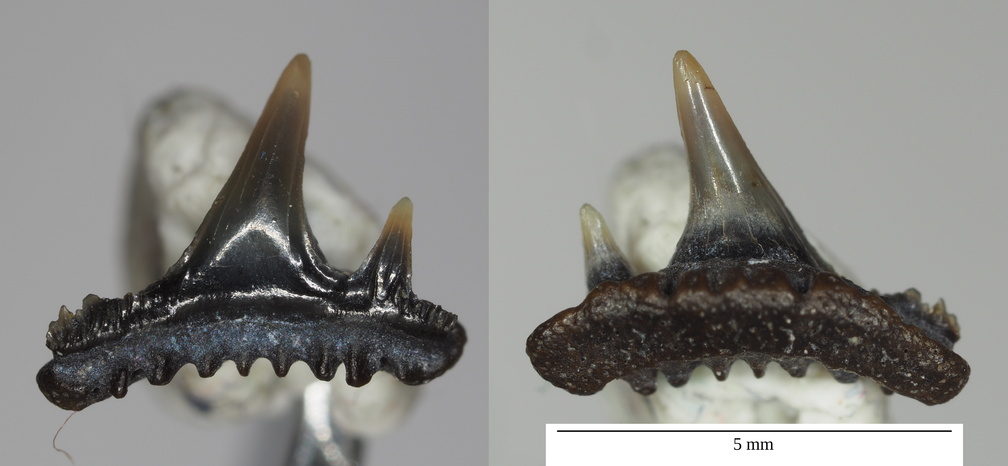
Synechodus sp. shark tooth. Fili park, Jurassic
How did people react when they saw some paleontologists in the park? Most people didn’t even notice me. Some came to ask some questions about what I search and what we find here. When I was coming back home, exhausted because I had dug the whole day, with a heavy backpack because of all the equipment and finds, I may have seemed strange to some people in the underground because I carried a large shovel and had mud traces on my face.
Fossils from Fili in my collection
-
Thanks to the preservation of ammonites from the Moscow area, Alexander Mironenko, a well-known specialist of ammonite anatomy, could make a lot of discoveries about their soft-body organization. ↩︎
-
Which doesn’t mean we should only focus on whole specimens. Sometimes fragments have more scientific value. ↩︎
-
People usually confuse me with a gold panner because I use a sieve to search small fossils like shark teeth. Gold panners don’t use sieves but pans, so rocks and sands are washed away and gold, much denser that everything else, stays on the bottom. A sieve would be useless here, as it will let the small gold flakes through. But many people don’t see this difference and just remember that in films, gold panners shake some round things in water. ↩︎