Cretolamna – the marine reptile-eating shark and its 50 million years history
The genus Cretolamna is remarkable in the evolutionary history of lamnoid sharks. This genus appeared approximately 100 million years ago and became extinct 50 million years ago, surviving the end-Cretaceous mass extinction. It is the direct ancestor of the genus Otodus, which comprehends the largest known marine predators, including the well-known megalodon, a 20 m shark. Cretolamna may have been preying on plesiosaurs and mosasaurs, themselves fearsome predators more than 7 m long…
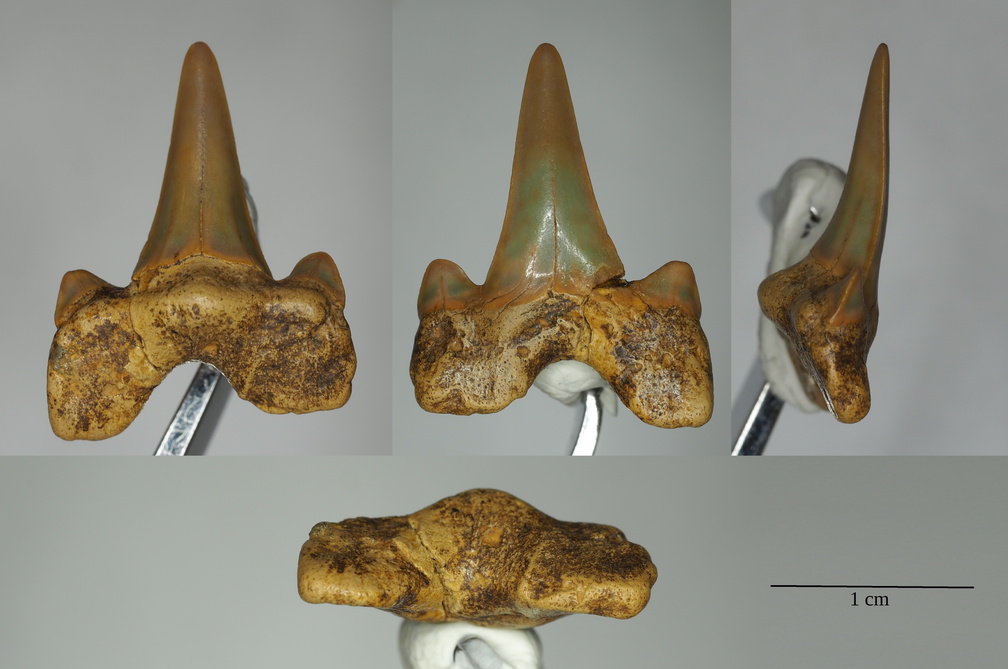
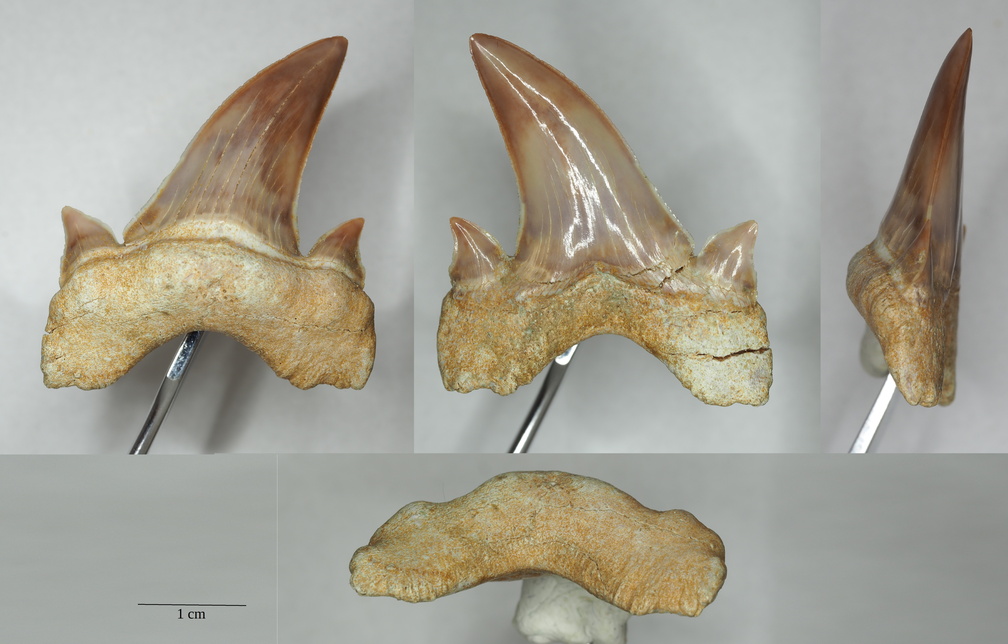
Cretolamna appendiculata. tooth. Upper Cretaceous, around 90 million years old.
Glickman (Glickman, 1958b) described the genus Cretolamna for fossil teeth of Lamna appendiculata that became the type species. Teeth of Cretolamna were previously assigned to modern salmon sharks Lamna for somewhat similar teeth between these two genera. This similarity is however linked to convergence, as both forms have similar ecological niches. Glickman’s data proves that there cannot be any close genetic link between Cretolamna and Lamna : the teeth of the species C. appendiculata, 80 millions years older, have nevertheless a broader tooth crown, and therefor a better developed cutting function allowing to prey on larger animals. A regression towards narrower crowns is impossible, as it would be very unfavorable to the species. Teeth of Lamna situated at the posterior-most edge of the jaw are highly reduced, and will probably completely disappear with evolution, meanwhile no reduction is observed in the posterior teeth of Cretolamna. These observations show that the dentition of Cretolamna has already followed a long evolution to adapt to its ecological niche, while Lamna is a recent genus.
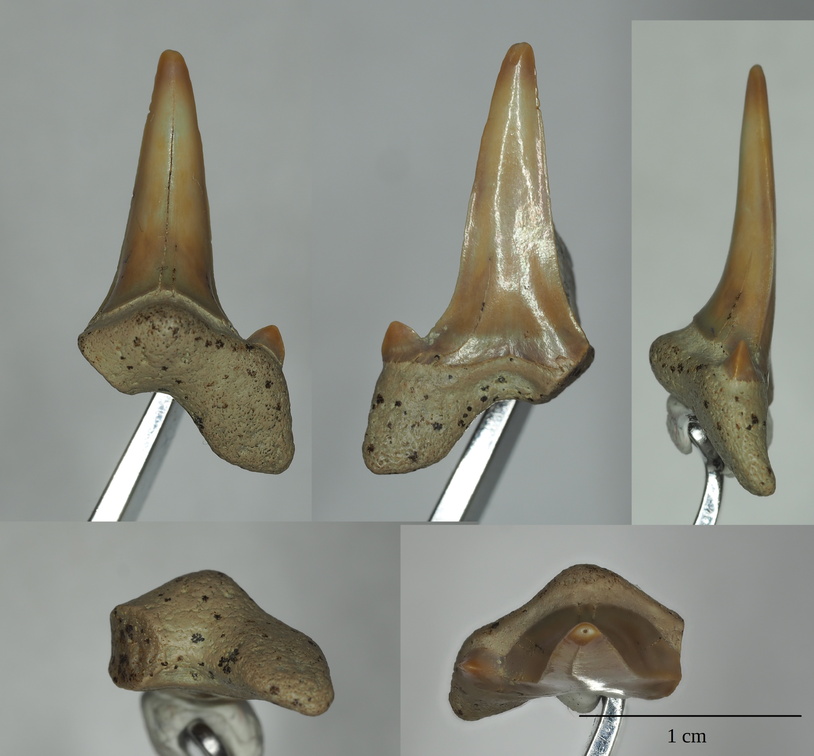
Cretolamna appendiculata. tooth. Upper Cretaceous, around 90 million years old.
There are two spellings of this genus - CretOlamna and CretAlamna. The second one is a typographical error that appeared in Glickman’s article published in 1958. Glickman stated it was an error and continued to use the spelling Cretolamna, as most paleontologists at that time. However, other researchers later insisted on the spelling Cretalamna, which is now used as frequently as the first one.
During its existence, Cretolamna had a global distribution. Cretolamna appears in the Cretaceous around 100 million years ago. Teeth found in Cretaceous sediments are usually of medium size (around 20 mm), and only rarely exceed 25 mm. Tooth morphology indicates an ecological niche similar to that of extant Lamna for most species. Cretolamna were active predators preying mostly on fish, as well as on cephalopods. Broader teeth are larger and characterize species that attacked very large animals. It was thought for a long time that C. appendiculata was the most widespread species during the Cretaceous, and that it existed for 50 millions years. However, a study (Siversson et al., 2013) shows that the evolution of Cretolamna was much more complicated. species with a cutting dentition, specialized in hunting large prey, evolved several times from smaller, less specialized forms. Siversson et al. Described 6 new species of Cretolamna that existed between 98 and 82 million years ago (Upper Cretaceous).
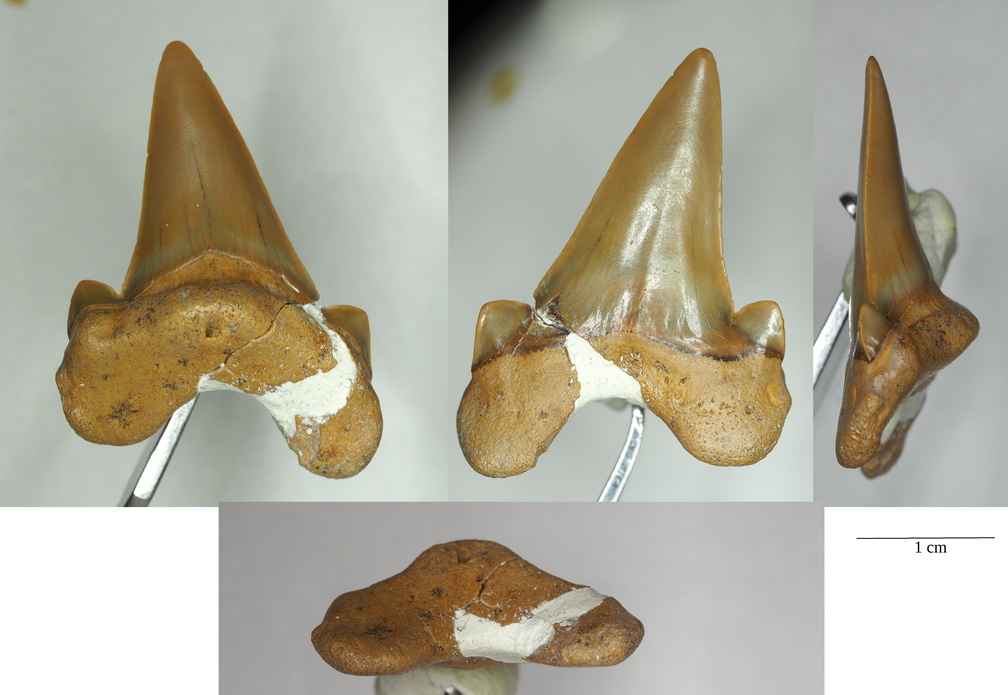
Very broad Cretolamna tooth. Upper Cretaceous, around 90 million years old.
The skeleton of a 7 m long plesiosaur 1 , Futabasaurus suzukii, found in Japan had 5 Cretolamna teeth stuck in its bones, and 82 other Cretolamna teeth were found during the extraction of the skeleton. Several shark had eaten the plesiosaur carcass and lost some of their teeth (Shimada et al., 2010). Shimada et al. Assign this case to scavenging, but some aspects indicate that it is more likely to be a shark attack. The scavenging version doesn’t explain why so many teeth were found next to the skeleton. Teeth of sharks specialized in scavenging, Hexanchidae and Crassonotidae, are commonly found next to marine reptile skeletons (i. e. Paparella et al. 2017, Serafini et al. 2020). There is always a lot less teeth that what was found next to Futabasaurus suzukii, meanwhile Cretolamna teeth are much better attached to the jaw than in the simplified dentition of Hexanchidae. On the other hand, during the attack of a large living reptile, the loss of a great number of teeth is very likely. Shimada et al. explain the high number of teeth by hypothesizing that scavenging occurred multiple times, but in this case it is difficult to explain why all the teeth belong to one species, considering that Cretolamna was not a scavenger but an active predator (which obviously doesn’t exclude occasional scavenging). The sense of smell in lamnoids being not best developed among sharks (see Glickman, 1980), sharks like Hexanchidae, specialized in scavenging and having a better sense of smell, must have been advantaged. The version that Cretolamna attacked a living but vulnerable plesiosaur is one of the likely possibilities.
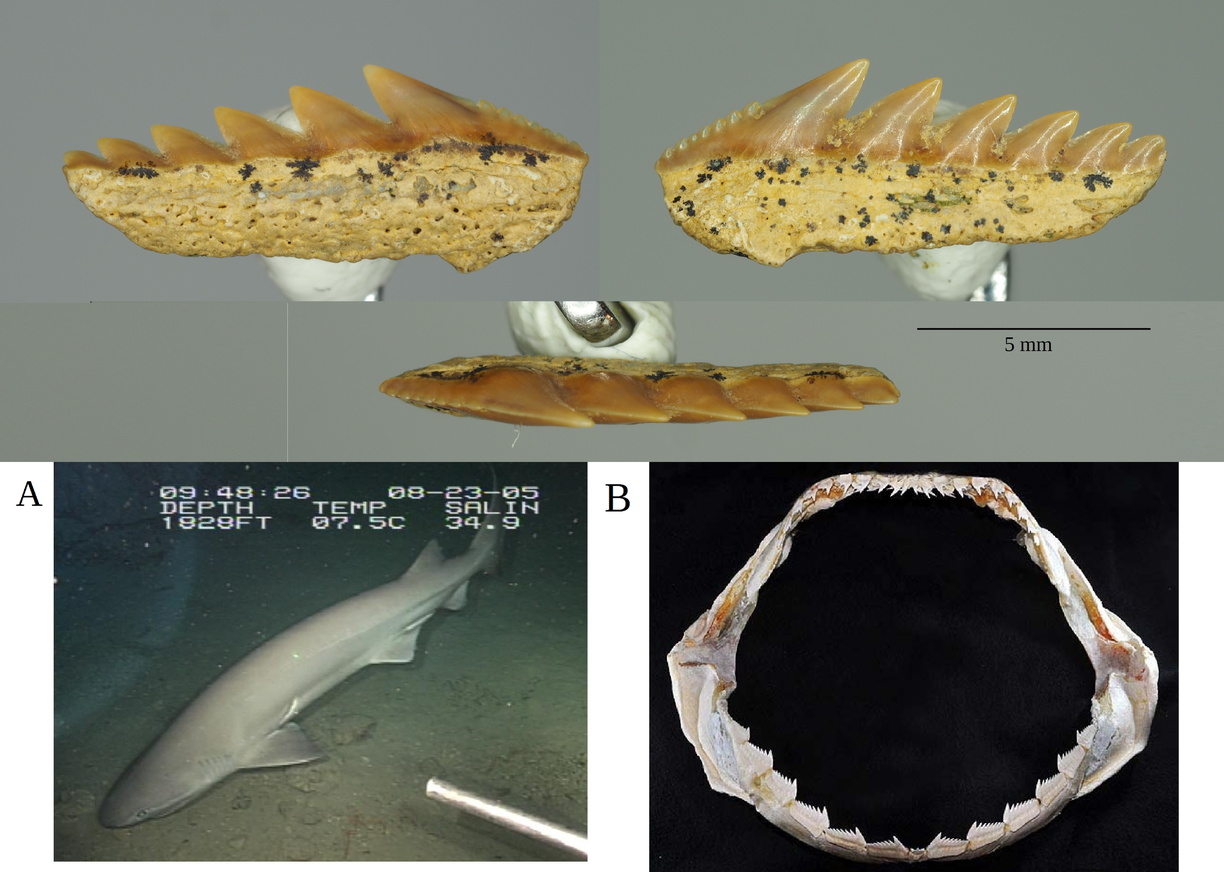 Hexanchus shark tooth. Upper Cretaceous, around 90 million years old.
At the end of the Cretaceous period, plesiosaurs became extinct, and their niche was filled with another group of reptiles - mosasaurs. Cases of lamnoid sharks scavenging on mosasaurs are known (Everhart, 2004). Cases of lamnoid sharks attacking mosasaurs are also documented (Rothschild et al., 2005), and those are undoubtedly attempts to kill living animals. As they were not fatal, mosasaur bones present traces of subsequent bone growth (healing) and infection. Mosasaurs were probably preys of Cretolamna (C. sarcoportheta, C. borealis). Cretolamna teeth became larger and broader at the end of the Cretaceous.
While some sharks became extinct at the end of the Cretaceous, Cretolamna was not affected by the Cretaceous-Paleogene extinction (65 million years ago), and survived until 50-46 million years ago. Paleogene forms include large predators as well as less specialized species.
Cretolamna is the ancestor of all Cenozoic otodontids : genera Otodus, «giant» sharks like Otodus megalodon, and Palaeocarcharodon, sharks with blade-like serrated teeth, descend from Cretolamna. The origin of otodontids Parotodus and Megalolamna is still not very clear, they descend either from Cretolamna, either from primitive Otodus. The concurrence with more evolved otodontids is thought to be the main cause of Cretolamna’s extinction.
 Otodus minor shark tooth. Paleocene, around 60 million years old.
 Otodus obliquus. shark tooth. Eocene, around 50 million years old.
References
Glickman L. S., 1958b. On the rates of evolution of lamnoid sharks [in Russian]. Doklady AN SSSR, 123(3) : pp. 568-571.
Glickman L. S., 1980. Evolution of Cretaceous and Cenozoic lamnoid sharks [in Russian]. Ed. Nauka.
Paparella I., Maxwell E. E., Cipriani A., Roncacè S., Caldwell M. W., 2017. The first ophthalmosaurid ichthyosaur from the Upper Jurassic of the Umbrian–Marchean Apennines (Marche, Central Italy). Geol. Mag., 154(4) : pp. 837-858.
Rothschild B. M., Martin L. D. and Schulp A. S., 2005. Sharks eating mosasaurs, dead or alive? Netherlands Journal of Geosciences, 84(3) : pp. 335-340.
Serafini G., Amalfitano J., Cobianchi M., Fornaciari B., Maxwell E.E., Papazzoni C.A., Roghi G. & Giusberti L., 2020. Evidence of opportunistic feeding between ichthyosaurs and the oldest occurrence of the hexanchid shark Notidanodon from the Upper Jurassic of Northern Italy. Riv. It. Paleontol. Strat., 126(3) : pp. 629-655.
Shimada K., 2007. Skeletal and dental anatomy of Lamniform shark, Cretalamna appendiculata, from Upper Cretaceous Niobrara chalk of Kansas. Journal of Vertebrate Paleontology, 27(3) : pp. 584-602.
Shimada K., Tsuihiji T., Sato T. and Hasegawa Y., 2010. A remarkable case of a shark-bitten Elasmosaurid plesiosaur. Journal of Vertebrate Paleontology 30(2) : pp. 592–597.
Siversson M., Lindgren, J., Newbrey, M.G., Cederström, P., and Cook, T.D. 2015. Cenomanian–Campanian (Late Cretaceous) mid-palaeolatitude sharks of Cretalamna appendiculata type. Acta Palaeontologica Polonica, 60(2): pp. 339–384.
Useful links
Cretolamna on gallery.lsglab.org.
Otodontidae on gallery.lsglab.org.
-
The plesiosaur could be even larger - up to 9.2 m. ↩︎